
















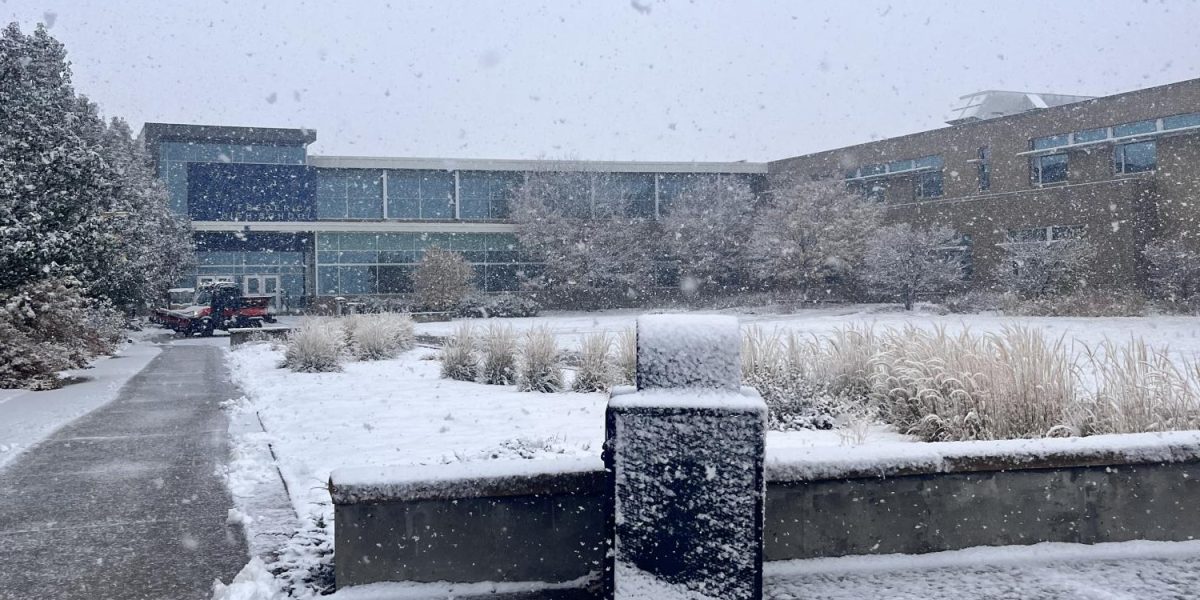
Today’s forecast is the first since spring to call for snow, which means winter is here. As we enter into the snowy season, there’s a big thing that is currently in the back of every teacher and student’s mind: will we have real snow days?
Currently, the district superintendent cancels school when weather conditions make it too dangerous to go to school or learn at school. While this usually happens due to heavy snow and ice, inclement weather days can also be called for severe wind, below-freezing temperatures, or weather so cold that buses won’t start. On these days, buildings close and students and staff stay home.
The issue with this is that we still have to go to school even when we cannot go into the school. On inclement weather days, students are expected to have synchronous classes at home via Webex. We have to log on, get our attendance taken, listen to the lecture, and then spend the rest of the day going into Schoology and completing our work from home.
This started right after we came back in person after COVID under our old superintendent, Dr. Don Haddad, and we’ve endured these “work from home” days for four years. Far from a trend, we are an outlier with this policy: not a single neighboring school district—Boulder, Thompson, Estes Park, East Grand, and Welds 1, 5, and 8—requires remote learning on bad weather days. This isn’t due to money or access either: Denver, JeffCo, Douglas County, Cherry Creek, Aurora, and Adams 12 are all larger than St. Vrain, and not a single one requires remote learning during inclement weather.
Granted, we aren’t the only ones. Poudre Schools have the option for virtual learning if inclement weather is known well in advance. The biggest school district in the US has also done it: last year, New York City public schools robbed 1 million students of their first snow day in two years by requiring virtual learning.
But just because others had the same bad idea doesn’t make the idea better. Now that there’s a new superintendent in SVVSD, it’s time to drop this failed experiment and bring back the traditional no-requirement snow days.
One reason these “work from home” days are pointless is because of the “lessons” we get on those days. It’s pretty rare that a teacher does adjust their plans to deliver what they were going to teach in an all-online format. Most of the time, teachers either have special “snow day” lessons that don’t tie into the unit or topics we’re learning, or they have a quick check-in and easy attendance assignment, which is just a waste of everyone’s time. This is without even going into elective classes like Ceramics, Ironworks, Drama, and Study Hall that don’t really have work that can be done at home or a need to make up missed class time.
It’s not like students log on anyway—Frederick teachers say that roughly half of all students log onto their lesson for attendance. Some accidentally sleep in, some forget that there is online class, and some just don’t feel like showing up. Holding a class with only half the students and assigning something that only a few students will complete is a waste of time for teachers. For students, it’s worse: it’s not only a waste of time for those that show up, but also it lowers the grades and hurts the attendance of those who don’t show up.
This is unfair to the students that can’t show up. When snow days come, so do power and internet outages, and some students (and teachers) are not able to log onto their virtual classroom. There are also some families that don’t have the internet bandwidth to have every child streaming live video and audio at the same time.
Speaking of families, parents are also affected by bad weather and may need the internet for a work-at-home day, which takes priority over learn-from-home time. The reverse is also true: a parent could still have to go into work, and their high schooler has to babysit all the younger siblings that would otherwise be in school—which means they have more important things to do than learn.
Having the old snow days back is not just to skip school on a random day but to create equity among students. Inclement weather days should be a mental health break for all students and teachers. If someone is falling super behind, it could be a day to catch up on schoolwork, but it shouldn’t have to be a day to take on more difficulty.
It’s more than just that worthwhile learning doesn’t actually happen during these virtual work-from-home days—students actually learn more with a traditional snow day. The learning isn’t academic, though—it’s practical.
In an interview with Vox, Dr. Melanie Killen of the University of Maryland argues that snow days help children develop social cognition, which is basically knowing how to interact with other people. Killen, a professor of human development, says that while children regularly interact in a classroom, behavior is scripted and enforced; in contrast, social cognition is only really developed in unstructured, free-form social settings where normal rules are suspended—like a snow day.
Killen says that using inclement weather for virtual learning instead of a day away from school “undermines the power of peer interactions, which are fundamental for contributing to change and development.”
Killen argues that society has moved away from free-form play by trading recess for seat time and filling what were wild and spontaneous summers with structured activities and appointments. This is leading to rise in the number of children struggling with social cognition. While a single snow day wouldn’t reverse these trends, every opportunity for unstructured play is critical when the opportunities are scarce.
Snow days are not just a day off from school but a day off from everything: schedules, obligations, rules, and deadlines. And how we figure out what to do when given such freedom is important—it’s the best lesson a student could learn when the weather outside is frightful.
So Dr. Kapushion, instead of focusing on productivity, let’s focus on mental wellness. When the weather gets rough, students and families need less stress, not more. We’ve tried the work-at-home approach, and it’s clear that our new leadership should embrace the old ways.