




















Happy New Year! The most exciting aspect of a new year is all the change that January 1 brings. Countless people all over the world make resolutions to better themselves in the coming year. This year, ours is to post regularly on our social media @fredericklantern on Instagram, Facebook, and Bluesky.
Copyright also gets a refresh every January 1 as several new works enter the public domain. This January 1 sees copyright protections expire on literay masterworks As I Lay Dying and Private Lives. As for film, the Best Picture-winning All Quiet on the Western Front (directed by Lewis Milestone), the Marx Brothers film Animal Crackers, and the last of Hollywood’s pre-Hays Code films all become free use.
Songs now in the public domain include “Georgia on My Mind,” “Dream a Little Dream of Me,” and “I Got Rhythm” (but keep in mind that just because a song’s composition is in the public domain does not mean all recordings of the song are). Two mystery-solving women—Nancy Drew and Miss Jane Marple—also enter public domain. So do Minnie Mouse’s dog Pluto and monochromatic flapper Betty Boop (but only her early human-dog hybrid form because both copyright and Fleischer Studios are very weird).
And in Colorado, the new year means new laws.
The Colorado General Assembly gathers to make and argue new laws starting on the second Wednesday in January. They meet for 120 days (excluding holidays and weekends) at 10:00 a.m. Monday and 9:00 a.m. Tuesday through Friday. This year’s session runs from January 14 to May 13, and laws that pass and get signed by the governor will go into effect on either July 1 or the following January 1. So for Colorado, New Year’s Day is also New Laws Day.
Here are the 21 new laws that go into effect today, in no particular order.
 SB25-053: Bison become big game
When Colorado became a state in 1876, anyone could shoot and kill a wild bison on sight. Hunting turned to overhunting, and by 1908, there were no wild bison anymore. The only 18 bison living in Colorado could all be found at the Denver Zoo.
With the wild bison dead and all remaining bison in captivity, Colorado made efforts to regrow bison populations through ranching. Thus, like other ranch animals, bison were classified as livestock by the state. Politicians figured this would work until a time in the future when bison populations could exist outside a fenced field.
That time is now. While Colorado has yet to introduce bison into the wild, wild bison from Utah have crossed into the state since 2007. As more bison cross and stay in Colorado each year, the state now has a permanant wild population. This led to SB25-053, which makes a new legal distinction between livestock bison and wild bison.
After today, wild bison are now classified as big game and will be managed by Colorado Parks and Wildlife. Like other big game in the state, hunters can enter a lottery to buy a permit to hunt wild bison. Each permit will be for a single bison and will cost $374.22 for Coloradans and over $2.7k for others. However, hunters beware: illegally killing a bison will result in a $10k to $100k fine, imprisonment for up to a year, and a suspended driver’s license.
 HB25-1090: Consumers are protected from junk fees
Starting today, a person or business in Colorado must provide the entire maximum price that a good or service could cost in what they verbally offer to customers and display in advertisments (with the exception of taxes and shipping fees).
What does this mean? Not much for small purchases, as most stores already display the total price of items before tax. The biggest change to everyday buying will come at restaurants, which now must post extra charges in their menus. This includes any Kitchen Investment Fee (KIF) or automatic gratuity that will be charged.
Big purchases, however, will see big changes, as they now have protection from surprise charges. Take, for example, buying a car from a dealership. Let’s say the windshield of the used 2024 Jeep Wrangler you want says $45,500. Then you get ton the seller’s office and discover a $900 charge for document processing, a $250 detailing prep charge, a $500 paint protection charge, a $300 advertising fee, a $50 title transfer fee, and another $50 fee for the CarFax history—and your car is now $2000 more.
HB25-1090 prevents this deception: starting January 1, all mandatory fees must be included in the upfront price.
This bill will most significantly impact home rentals. Landlords need to include every required fee a tenant will face in the price advertised. For example, if a $1200/mo. duplex has a $50/mo. trash fee and a $125/mo. parking fee, the landlord must advertise the rental as $1375/mo. Additionally, landlords in Colorado may no longer charge tenants administrative service fees, common area maintenance fees, payment processing fees if no free method is available, or late fees for non-rent charges. Fees also may not increase by more than 2% or $10/mo. over the course of a one-year lease.
 SB25-079: Users of crypto ATMs get more protections
This law (called the Colorado Vending of Digital Assets Act) regulates cryptocurrency… or rather, crypto ATMs. Crypto ATMs are physical kiosks that can turn cash into crypto or crypto into cash for a 5%—15% fee. While convenient for crypto enthusiasts, crypto ATMs have been the recent target of scammers. These criminals hack the ATMs to access to a victim’s crypto wallet or redirect transactions to their own crypto wallet.
The VDAA requires crypto ATM operators to disclose the risks of using a ATM not backed by a traditional bank. Crypto ATMs must also provide users with both an electronic receipt and a physical receipt of the transaction. These two practices should reduce the incidences of ATM users getting tricked.
First-time crypto ATM users (those who have been using crypto ATMs for less than a week) may only conduct $2000 worth of transactions per day. However, if they get scammed and they report it within 72 hours, they can get their (physical) money refunded.
Those who have used a crypto ATM for longer than a week have a $10,500 daily transaction limit, but if they are scammed, they won’t receive any reimbursement.
 HB25-1002: Health insurance must cover mind and body equally
All medical insurers in Colorado now have to cover mental health issues to the same degree as physical health issues. This law prevents insurance companies from providing less coverage for mental health at a time when mental health concerns are at an all-time high. Mental health-related ER visits by Colorado children and adolescents have increased by 158%. At the same time, Coloradans are nine times more likely than the average American to need an out-of-network provider for mental health services.
This doesn’t mean that insurers now have to cover every mental health treatment—they just can’t discriminate in their coverage. What that means practically is that insurance companies in Colorado must follow guidelines developed by the American Academy of Child and Adolescent Psychiatry (for under 18) or the American Association for Community Psychiatry (for over 18) when confirming or rejecting coverage. Additionally, if the insurer does reject coverage, they need to disclose to patients how they came to that decision.
This won’t ensure everyone will get the help they need, but it does mean that cost should no longer dictate if someone gets treatment for their depression, anxiety, or substance abuse. This is especially relevant for teens. More than a third of Colorado teens who report having major depression also say that they’ve been unable to afford treatment.
 H.B. 25-1179: Car insurance now covers car seats
Car seats can be crazy expensive: while simple models are around $50, they are often hundreds of dollars. Last year, Colorado raised the age requirements for booster seats, and the state requires all vehicles to carry collision insurance. At the confluence of all of this is HB25-1179: if someone gets in a car wreck and the crash damages their “child restraint system,” they can file the loss under their current collision coverage and get money for a new safety seat.
 HB25-1154: Red tape cut for disability services
Under current law, Colorado must provide those with blindness, hearing impairment, or mutism that affects their day-to-day communication with resources so they can communicate. Here’s how this currently works:
- telecommunications companies charge their customers a monthly Telephone Disability Access [TDA] fee of $0.06 per line
- these companies give all money raised by the fee (around $5.5 million a month) to the state public utilities commission
- Coloradans needing communication accommodations contact the Colorado Division for the Deaf, Hard of Hearing, and Deafblind, a state advocacy group
- Colorado Division for the Deaf, Hard of Hearing, and Deafblind sends requests to the public utilities commission, who then approve or deny each request and give the Colorado Division for the Deaf, Hard of Hearing, and Deafblind money from the TDA fund…
- …unless the service requested is reading for the blind, which has to go through the state librarian
This new law streamlines this overcomplicated process. First, it creates a new division of the state department of human services called the Communication Services for People with Disabilities Enterprise (CSPDE). Starting January 1, the money raised from the TDA charge goes directly to CSPDE. Coloradans needing communication accommodations of any kind also now go straight to the CSPDE for assistance and approval. This means quicker delivery of disability services while freeing up the utility commission and state librarian for other tasks.
With this new law also comes an increase to the TDA charge. Starting January 1, Coloradans will pay $0.08 per line per month (around $0.96/year more for a family of four).
 HB25-1285: Defining who a Veterinary Professional Associate is
In 2024, Colorado voters passed Proposition 129, which established veterinary professional associate role in the state veternary licensure. Essentially, a VPA is not a full vet, vet technician, or vet specialist but can provide some level of veterinary care for animals. The VPA track will ideally attract more people into the veterinary profession and ease the high demand for vet care without requiring the same rigorous experience and training as a full vet.
Prop 129 was very, very vague, so HB25-1285 clarifies exactly what a VPA can and cannot do. Essentially, a VPA can do anything that a supervising vet says they can do “within the training, experience, and competency of the VPA” and the state board of veterinary medicine guidelines. However, VPAs must always be under the supervision of a licensed vet (who can supervise up to three VPAs).
This also seems vague, and that’s intentional. The politicians who passed this law want the state board to determine the specifics since they are the experts. This direct supervision also ensures that animal owners will not be in a situation where there is just a VPA and no vet. Large farms, rural vet practices, and animal shelters all offer ideal environments for this arrangement: several VPAs will practice basic care while the one vet treats advanced maladies.
For those considering becoming a VPA, CSU is the first college in the country to offer VPA training. VPAs must have a biomedical undergrad and a MS in Veterinary Clinical Care. This is the same schooling as a licensed vet but without the in-the-field experience or testing.
 HB25-1238: Gun shows must turn away teens, plus other accountability
Gun shows in Colorado have had some basic guidelines for a couple of decades: all the promoter needed to do was make sure that every seller followed three rules. One, all sellers need a state permit or federal license to sell firearms. Two, sellers must conduct a background check on anyone buying a firearm. Three, sellers must wait three days before delivering the firearm to the buyer. While a promoter could get in trouble if a seller violated one of these rules, they could generally conduct business however they liked.
Starting on January 1, promoters holding a gun show now have a greater degree of accountability. First, no one under 18 can attend a gun show unless accompanied by a parent, grandparent, or legal guardian—just any person over 21 won’t do. If authorities catch an unaccompanied minor attending a gun show, they’ll charge the promoter with a class 2 misdemeanor for a first offense. The promoter gets a class 1 misdemeanor for a second offense and, in addition to criminal penalties, cannot hold another gun show for five years.
Gun show promoters must also carry liability insurance for the event and file a security plan with the local police. The safety plan must show that staff will monitor all entrances and exits and that the main entrance/exit and parking lot have video survalence at all times. Certain cities and counties in the state already had these requirements for local shows, and the Colorado General Assembly used them as a basis for these laws. These new rules apply to all gun shows except “gun collector shows” that exclusively feature and sell antique firearms (made before 1898) and their replicas.
Additionally, sellers at gun shows now need to not just have a state permit or federal license to sell but also display that permit at their booth or staging area. No guns at the gun show may be loaded, and, unless it is actively being handled by the seller or a potential buyer, all firearms must be locked inside a case or safe or affixed to a display wall with a lock. Finally, after conducting a background check and enforcing a three-day waiting period, the gun seller must give a gun owner’s information pamphlet to the buyer along with their firearm. This pamphlet must instruct gun owners on how to properly store and secure guns and how to report lost or stolen firearms.
These new laws are facing a federal lawsuit by the National Rifle Association and other anti-restriction advocates.
 S.B. 25-158: State agencies must background check gun providers
This is another firearm restriction law, but it only applies to state agencies (like police and wildlife rangers), not regular folks. When a state agency needs work-related firearms, they can’t just go to the local gun store. Instead, departments must take independent bids for a supplier (though they can show bias to a Colorado provider over an out-of-state provider).
Bidders must provide not only their federal license to sell firearms but also a safety disclosure that includes an inventory of the company’s lost and stolen guns, demonstrates a company-wide respect for firearm safety, and proves the company has measures to prevent illegal firearm trafficking. The purpose of this law is to ensure taxpayer money isn’t going to firearms manufacturers with irresponsible or unsafe business practices.
Once a firearm purchased by a state agency has outlived its use or is classified as an unneeded surplus, it must be destroyed. The same goes for firearms confiscated in criminal interactions (unless needed as evidence in an active case), stolen guns that go unclaimed by their registered owners, and arms acquired from gun buyback programs. All firearms that a state agency acquires, keeps, and destroys must be logged in a permanent record.
 HB24-1121 & HB25-1330: Expanding Colorado’s Right to Repair
In 2024, Colorado’s Consumer Repair Bill of Rights Act became the first in the nation to require the makers of motorized wheelchairs and farm equipment to provide consumers access to the parts and instructions to repair that equipment at “fair and reasonable terms and costs.”
In 2024’s General Assembly session, Colorado expanded this law with HB24-1121 to cover anything with a computer chip except:
- motor vehicles (land, sea, and air)
- electric vehicles
- medical devices other than wheelchairs
- emergency radios
- alarm equipment (both fire and security)
- building and road construction equipment
- renewable energy equipment and generators
- video game consoles
This law went into effect on January 1, 2026, but before it did, 2025’s assembly passed HB25-1330 to add one more exemption: devices, components, and systems designed to perform or facilitate quantum information processing. This not only takes supercomputers and particle accelerators off the table for repairing oneself but also means that software based on advanced algorithms for tasks like financial modeling, weather forecasting, or machine learning.
 HB22-1345: No PFAS allowed in cookware, cleaners, camping, and hygiene
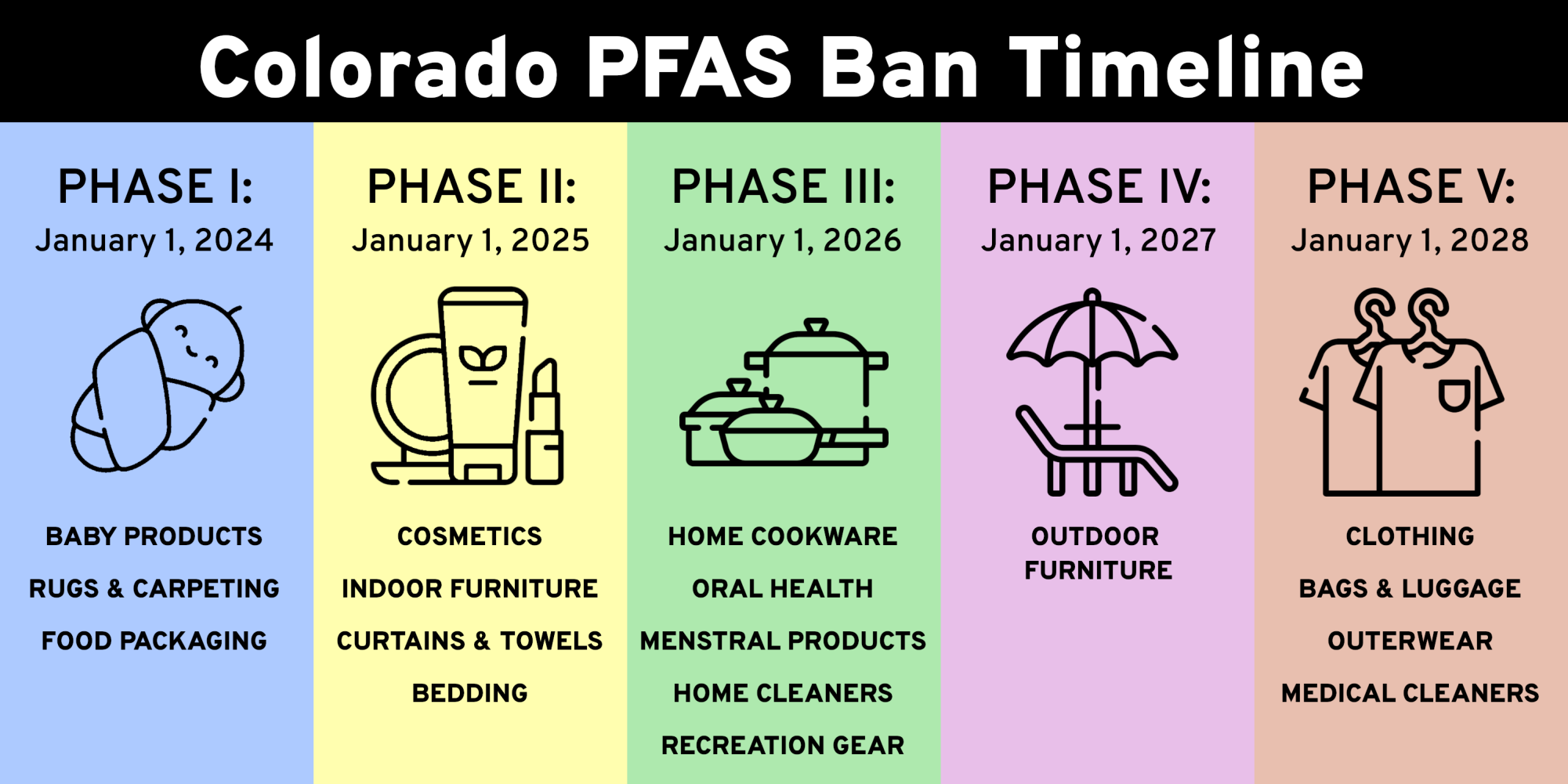
In 2022, Colorado became the first state to start banning perfluoroalkyl and polyfluoroalkyl chemicals (PFAS). These go by the name of “forever chemicals” because their long carbon chains are so hard to break apart that they can last thousands of years. Governments around the world have banned PFAS in the past decade as they have been linked to every type of cancer, weight gain, and immunity suppression—worse, they are so prevelant that 98% of people have trace amounts of PFAS in their body right now. The easiest way to find if a product contains one of these chemicals is to look on an ingredient list or MSD sheet for any chemical containing the word “fluoro,” the F in PFAS.
Phase I of the ban happened in 2024 and banned PFAS in rugs, packaging, and children’s items like wipes and sleeping mats. Last year was Phase II, which banned PFAS in cosmetics and indoor furnishings, including upholstery, pillows, bedding, and cloth towels.
January 1 starts Phase III. This bans PFAS in all cleaners except those used for medical equipment. Cookware containing PFAS (like teflon-coated nonstick pans) also cannot be sold in the state anymore. Hygiene products also cannot contain PFAS: common items that often contain forever chemicals include dental floss, adult diapers, and menstral pads and tampons (48% of which tested positive for PFAS in 2022). For sports enthusiasts, the PFAS ban affects certain brands of ski wax and newly laid artifical turf (existing turf fields with PFAS can remain).
Phase IV comes next year and will ban PFAS in outdoor furnishings, and Phase V in 2028 will ban PFAS in medical-grade cleaning products, commercial cookware, and all non-medical textiles, including backpacks, purses, shoes, outerwear, yoga pants (25% have them), bras and underwear (65% have them), and other apparel.
Other laws in effect on January 1, 2026:
HB25-1030: All public school and health facilities in Colorado have to meet or exceed the accessibility standards in the International Building Code, as do all buildings in any area that does not have an established local building code.
HB25-1056: When a wireless telecommunications facility (i.e., cell phone service building) needs upgrades, the local government must approve and permit or reject the application within 90 days—otherwise, the application will be considered approved. If building a new facility, the application must be approved or denied within 150 days.
HB25-1222: Health providers must cover the cost of pharmacy couriers who deliver prescriptions to rural clients and reimburse rural pharmacies at the same price point as urban pharmacies.
H.B. 25-1236: When applying for a lease, a tenant that plans to use a state rental assistance subsidy to help pay their rent no longer has to submit a credit score or credit history check to a potential landlord.
HB25-1295: A food truck licensed in one Colorado municipality or county can now more easily get a permit to operate in any other Colorado county or municipality. Instead of passing all new inspections, the food truck can get their permit as long as they can show a valid business license, health permit, and fire safety permit from another Colorado local government. Trucks must still pay any required local fees for their permit.
H.B. 25-1296: Makes seventeen minor adjustments to the state tax code concerning medical marijuana exemptions, senior citizens, insurance companies, municipal governments, child care credits, overtime, historic buildings, farming deductions, wage garnishment, and small businesses.
SB25-004: Child care facilities (both home-based and commercial) must refund application, deposit, and waitlist fees to the parents that paid them if their child remains unenrolled after six months.
SB25-010: Individuals, insurers, and third-party carriers can now share and store health insurance legal documents without exposure to liability (as long as they follow the federal Uniform Electronic Transactions Act).
SB25-183: When Amendment 79 passed in 2024, voters added the right to abortion services to the Colorado constitution, and along with it, provisions that health insurance companies could not deny coverage of abortion services and that those with state-funded healthcare would have their services covered. This law changes the language in the Colorado statutes to match the new addition to the constitution.
All images come from Freepik.com unless otherwise indicated.