



















On December 5, Warner Bros. announced their sale to Netflix, one of three media companies that had made public offers to acquire them since September. Comcast (owner of NBC-Universal) and Paramount-Skydance lost their bids. Paramount, however, didn’t take no for an answer and launched a $108b hostile takeover of WB. Paramount gave the Warner Bros. Discovery (WBD) board 10 days to change their mind and sell to them.
On December 17, the WBD board made an unprecedented move: they not only rejected Paramount-Skydance (PSky) once more but also, through a public SEC filing, revealed the details of all the bids and the board’s distrust of PSky. The filing got as scathing and personal as an official government document could be, saying that PSky “consistently misled WBD shareholders” and the board of directors with unethical tactics and questionable business practices.
In covering this merger, we’ve covered why Netflix wants to buy Warner, why Paramount wants to buy Warner, and why Warner chose Netflix to be their business partner. In this article, we’ll look why Warner didn’t choose PSky. Typically, this isn’t the type of article we’d do because it’d usually involve a lot of speculation. However, Warner used their SEC filing as a rebuke of PSky and fully explained why, in WBD’s opinion, they didn’t want to partner with PSky.
Speaking of Partners…
Let’s take a moment away from merger talk and talk about my friend Wyatt. Wyatt Brown (but his friends call him WB).
Wyatt has a problem. After a bunch of failed relationships, he decided to change his life: he got a new life coach, slimmed down, changed direction in his life, and has been more successful at school than ever before. He feels ready to get into another relationship, but he can’t decide between the three girls he knows are crushing on him.
First, there’s his good friend Connie…
Wyatt has known Connie for, like, forever, and they’ve partnered together on a bunch of school projects. She showed Wyatt a slide deck with graphs of how she thinks it’d be efficient and beneficial to be a team in all aspects of their lives, including dating (or, as she put it, “cutting down on prom choice anxiety”).
However, Connie’s made it very clear that she just wants something for a couple of years before she goes off to college. They’ll have fun, give each other gifts, and she’ll steal his favorite hoodie, but a relationship with her would ultimately be temporary. She’ll invest a lot of time but not a lot of love in the relationship.
Then there’s Nanette…
Nanette’s the new rich girl at school. She’s bold and a bit rebellious—she has a reputation among teachers being disruptive, and none of Wyatt’s friends like her. It didn’t help that on her first day, she said a lot of nasty things about what she thought was wrong with her new school—words her enemies haven’t let her forget. Nanette told Wyatt that a big reason why she wants to date him is that he’s popular, and she hopes that he can bring her into the social circles that have snubbed her.
But it’s not just about popularity—she really does like Wyatt, and while she doesn’t know if it’s love yet, she can see a long-term future with him. She knows that Wyatt has his own stuff going on, and so does she, but she’s willing to make the time for him if he makes time for her. She knows that Wyatt’s friends are telling him that she’ll ruin his life and try to make him quit hanging out with them, but Nanette assured Wyatt that she doesn’t want to change him at all. In reality, she wants to be more like him.
And then there’s Peggy Sue.
Peggy is the dictionary definition of a pick-me girl. Before Wyatt was even ready to date again, she asked him out three different times. Loudly. In public. She even tried to bribe his coach into setting them up.
It took Wyatt a while to admit it, but he jumped back into the dating pool just so he can find another girlfriend and get Peggy Sue to leave him alone. However, this hasn’t seemed to put off Peggy Sue at all: she’s decided that Wyatt is hers. She declared that no one loves Wyatt more than her and, since her mom is good friends with Wyatt’s mom, that she’s the only girl that Wyatt’s parents will allow him to date.
And she’s got plans for Wyatt—she’s already picked out “their” college and told Wyatt that, as soon as they are official, she will take over his social media accounts because she wants to know where he is, who he’s talking to, and what he’s doing at all times. She’ll shower Wyatt with gifts and love, and his life will quickly change and never be the same.
So who should Wyatt pick? Calculating Connie, Newbie Nanette, or Pick-Me Peggy?
Paramount’s Pick-Me Approach
This tortured dating metaphor isn’t far from what actually happened in Hollywood. Warner Bros. has struggled for two decades with debt and devaluation as a result of acquisitions. When David Zaslav had Discovery buy Warner Bros. from AT&T in 2022, he made very clear that he was taking a page out of the HGTV shows that Discovery owns: he would “flip” Warner Bros.
Under a new coach, WB slimmed down, strengthened its assets, and got back its status as a major player. While many of Zaslav’s moves were controversial, he managed to nearly cut WB’s $50 billion debt in half in three years.
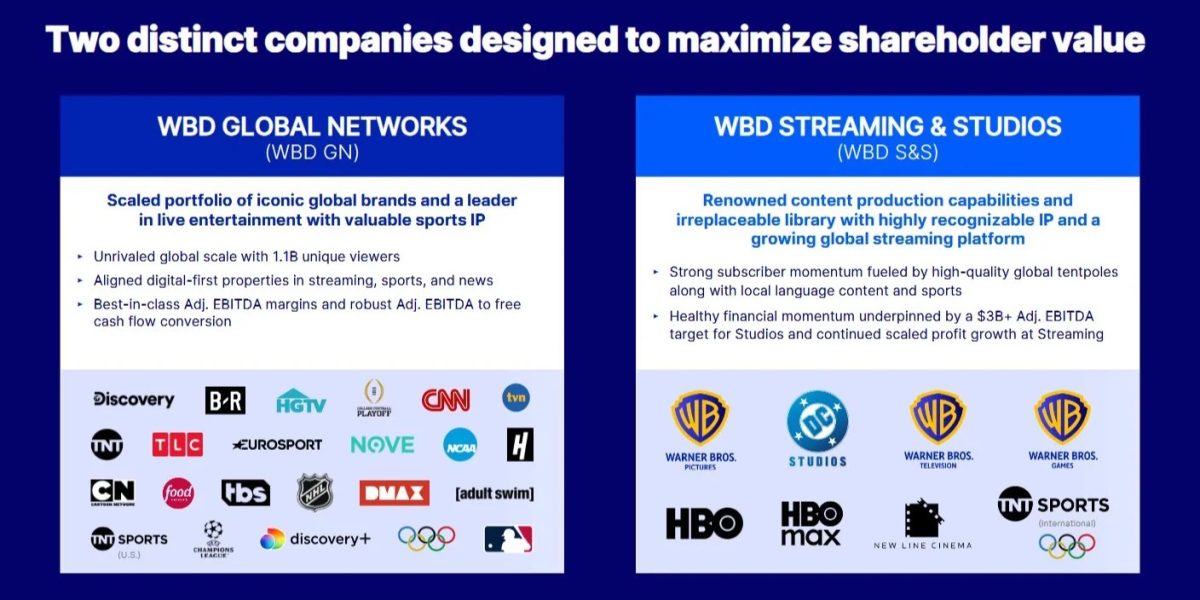
In June, Zaslav announced his next move to make Warner Bros. Discovery a healtier company: he wanted to unmerge them. The WB board approved a plan to split the company into two: Warner Bros. Studios and Streaming (including film, TV, gaming, DC Comics, and HBO/HBO Max) and Discovery Global Networks (including CNN, Bleacher Report, and all its cable networks).
This would happen in mid-2026 and leave DGN with most of the debt that has been weighing WB down. After getting rid of all the old baggage from the old ex, Zaslav wanted at least an additional successful year at WB to drive up the stock price further before the company was sold. However, someone else had different plans for Warner Bros. Discovery: Paramount-Skydance.
Paramount-Skydance Courts Warner Bros.
As detailed in our article about why Paramount-Skydance wants WBD, PSky and its CEO David Ellison want to consolidate more American media. By scooping up WBD, PSky would have a majority of the traditional cable channels while doubling the size of their movie and TV library and adding a profitable streaming service to its company. However, PSky would need to grab WBD before the company split in two–if they waited until after, there would likely be more bidders and a higher price.
To this end, Ellison reached out and met with Zaslav on September 14. Ellison offered $19 per share as a 60-40 cash-stock split—at the time, this would have been $11.40 in cash per share and 0.404 of a share in PSky. Zaslav met with the WBD board the next day to discuss the offer.
According to the December 17 filing, “the PSKY September 14 Proposal significantly undervalued WBD […] and that the stock consideration offered by PSKY consisted of non-voting Class B common stock of PSKY, ensuring that the Ellison family would retain voting control of the combined entity despite owning a minority of the economic interests in the combined company.”
Zaslav went to Ellison and said thanks, but no thanks. Ellison and the PSky board didn’t give up. After Zaslav met with Ellison and his father Larry, PSky offered $22/share on September 30 and $23.50/share came on October 13—WBD rejected these offer too.
On October 21, WBD announced that the company was for sale. They opened the bidding up to anyone that wanted the company, and gave a November 20 deadline for offers.

Pick-Me Paramount Launches a Bidding War
Why did WBD change its trajectory from splitting the compamy to a sudden sale? Well, Wyatt didn’t want to start dating again, but Peggy Sue forced him into a situation where he couldn’t remain single. PSky did the same thing to WBD.
WBD saw that the Ellison family wasn’t taking no for an answer, and they were concerned that PSky could stop playing nice and instead initiate a hostile takeover. Oracle, the company that gave David’s father Larry his billions, has executed successful hostile takeovers of PeopleSoft in 2005 and BEA Systems in 2008. Oracle even threatened a hostile takeover of Apple in 1997. WBD believed father would be willing to help son take them by force.
To fight a hostile takeover, WBD would have to lobby their shareholders not to sell or try to buy outstanding stock themselves. This would cost money, lower share value, and win or lose, WBD would likely get far less than the price they though the company was worth.
Thus, Zaslav and WBD decided to sell the company earlier than they planned. However, instead of just giving in to PSky, they opened it up to everyone. Like Wyatt, WBD was hoping that, if they couldn’t stay single, they could find a good partnership that offered the most value while requiring the fewest changes.

Choosing the Right Partner
As far as value, WBD had a specific number in mind, one it calculated when they announced it would split the company in two. WBD estimated that, post-split, the WB half of the company would trade around $28/share and DGN would trade $3—$6/share. Therefore, if they had to sell before the split happened, they want to sell in the $32—$36/share range. Any acceptable offer had to hit these targets.
WBD received four bids on November 20, but they felt that all of them undervalued their company. WBD announced that a private bidder (who turned out to be Starz) wouldn’t move forward, and there would be a second round of bids due on December 1… and that the bids should all be higher this time.
Each bidder obliged:
- “Connie” Comcast offered $35.43/share as a 15-85 cash-stock split and 49% control (voting shares and board seats) of WB-NBC-Universal after the company was split from Comcast in 3-5 years.
- “Peggy Sue” PSky offered an all-cash bid of $26.50. This offer came with no stock, no voting shares, and no board seats at Paramount.
- “Nanet-flix” offered $27.75/share as a 85-15 cash-stock split for just WB. Netflix wanted WB to stay pretty much as is (including keeping almost all current leadership and staff).
Looking at value alone, Comcast was the only one that hit WBD’s benchmarks. However, despite having the highest bid, Comcast had the lowest cash portion. While cash has a fixed value, stock is variable: if the value of the stock plummets while the deal goes through regulation, the deal is suddenly worth less. WBD passed on Comcast becauset they needed a higher portion in “guarneteed value,” i.e. cash.
PSky offered the most cash, but the total value fell short of WBD’s benchmark. Even after revising their bid to $30/share on December 4, WBD felt PSky wasn’t paying enough for their cable TV assets, which PSky only valued at $1/share.
Unlike the other two, Netflix only wanted the WB portion, so while PSky and Comcast had to aim for the $32 benchmark, Netflix only had to hit $28. While Netflix’s offer was slightly under the benchmark (-$0.25) it was still closer to its benchmark than PSky (-$2.00). Unlike the all-cash PSky offer, Netflix was paying $4.50/share in stock, yet the WBD board felt that this was acceptable for two reasons.
One was financial: they believed that the Netflix stock will be worth more in the future than either Comcast or PSky stock—Netflix currently has a $400b valuation, while Comcast and PSky have valuations of $110b and $14b, respectively.
Their other reason is where value crosses over into the other key component in a business deal: trust.
More Than Just Numbers
One doesn’t become a board member of a company just for want of money—taking such a leadership role shows that they believe in the company’s mission. It’s impossible to hold such a seat without defending the company’s reputation, investing in the company’s goals, and getting to know some of the company employees.
By picking Netflix, WB gets to retain control over their studios. Merger layoffs should be minimal because Netflix isn’t absoring WB but adding them with little overlap to their current business. Compare this to the Skydance merger with Paramount, which fired 2,000 people in October, and the Disney-Fox merger, which let go of nearly 4,000 people over the last five years).
This helps explains why WBD was fine with receiving Netflix stock as part of the deal. Comcast wanted to offer lots of stock to keep the shareholders involved while they restructured the company into something totally different—all that work wasn’t something WBD investors were interested in doing.
Alternatively, PSky’s early offers of stock didn’t come with voting power or board seats, which is why WBD preferred a complete cashout if they had to choose them.
However, Netflix has vowed to keep the business the investors helped build and keep it going. The stock offer allows the investors who are still sentimental about WB to stay connected to the business.
Now, scores of Hollywood figures have written think pieces about how Netflix won’t keep its word on this. However, WBD has full trust that Netflix will honor the terms of their final agreement, and their acceptance of stock shows that WBD trust both Netflix’s plans and business model.

WBD does not feel this way about PSky.
The Problem with Paramount-Skydance
According to the SEC filing, the approach that Ellison took when trying to make a deal with WBD had, for lack of a better term, very bad vibes.
One cause of this was the pressure put on them by PSky. WBD had to scrap their previously announced plans for next 18 monthsand sell the company because they felt they it was the only way to keep from just being consumed by an unrelenting Ellison. Ellison’s unwelcome pressure tactics include an offer he made to Zaslav of a compensation package worth “several hundred million dollars” if he ensured WBD wound up with PSky. Zaslav told Ellison that such an offer was inapproriate and reported it to the WBD board, who the filing says was upset by this ethical breach.
Once WBD announced a bidding war, they say PSky lobbied the WBD board and movie industry with a deceptive campaign to pick them. They believe that PSky recruited a handful of A-list actors and directors to send an anonymous letter to Congress telling them to block any acquisition by Netflix. PSky also sent a 4,000 word letter to WBD implying that a PSky-WBD merger would be the only one that would get US regulatory approval.
This last point ties in another point of discomfort for many on the WBD board: David Ellison’s politics. Ellison’s family has close ties to Donald Trump, and have made changes at CBS News to curry favor with him. The implication that the Ellisons could use their connection to Trump to block a deal with any other company personally rubbed major WBD stockholders and board members the wrong way. While no one from WBD has gone on record to say that Ellison’s politics affected their choice, the SEC filing is clear that PSky’s politics did play a factor in the board’s consideration.

More Than Just Vibes
Apparently, the final straw broke after WBD dug into how PSky planned to fund the acquisition: while Ellison promised his family fortune would backstop the entire deal, WBD’s lawyers discovered that there were several foreign investors PSky had not disclosed. $10b was coming from the sovergn wealth fund of Saudi Arabia; $7b from Abu Dhabi; $7b from Qatar; $1b from Chinese internet company Tencent; and $200m Affinity Partners, a firm managed by Trump’s son-in-law Jared Kushner.
Beyond the involvement of more Trump-affiliated individuals, this amount of foreign investment would require the Committee on Foreign Investment in the United States (CFIUS) to investigate the matter, which would slow down and complicate the sale. This, more than anything, lost WBD’s trust in PSky as they “consistently misled WBD shareholders that its proposed transaction has a ‘full backstop’ from the Ellison family. It does not, and never has.”
Even after Tencent and Affinity Partners agreed to bow out of the financing, WBD said the deal “would require substantial additional negotiation on key issues that PSKY had declined to address despite multiple rounds of specific feedback from the WBD Board and WBD’s advisors.”
One of these aspects is WBD’s current debt: one of the reasons Warner Bros. was splitting from Discovery next summer was that it would allow them to restructure their debt and avoid paying $1.5b to creditors. However, WBD would have to eat that cost if PSky takes over, since the bills would come due before the $108b PSky payday.

No Such Thing as No
What happens to a pick-me when they aren’t picked? Do they give up?
No—they fight.
Ellison launched a hostile takeover bid on December 8, accusing the WBD board of “a tilted and unfair process” because they did not choose the nominally highest bid. To that end, PSky offered the same $30/share deal as December 4 directly to the shareholders with a 30-day deadline to take it or leave it.
Ellison gave the WBD board ten days to consider the deal and avoid the expensive, protracted takeover battle WBD feared would happen. If PSky could persuade the WBD board to change their mind, they would only need 50% of WBD stockholders to back their play to win the company—though if WBD did this, they would owe Netflix a $2.8b breakup fee.
WBD, however, resoundly rejected the takeover offer, saying, “The PSKY offer is illusory [. . .] and would make Hollywood weaker, not stronger. Following a careful evaluation of Paramount’s recently launched tender offer, the Board concluded that the offer’s value is inadequate, with significant risks and costs.” Additionally, Zaslav and Netflix executives have started a press tour promoting their partnership and launched an informational website.
While WBD didn’t originallu want to fight a takeover, they are taking a bolder stance now because they aren’t alone in the fight. Netflix will front most of the money needed to fight off PSky, and with two companies fighting over them, WBD stock will go up, not down.
Plus, now that they are trying to take over a company under acquisition instead of just a company, PSky needs to get 90% of the outstanding WBD shares. Given that the largest shareholders of WBD (together holding around 12% of the company) are the Newhouse family and their company Advance Publications (which owns left-leaning media like The New Yorker, Vanity Fair, Wired, and Pitchfork), this is unlikely.
Even though Wyatt chose Nanette, his troubles aren’t over. He has to convince his friends that he’s not going to change, and he and Nanette need to get to know each other better. And there’s still Peggy Sue, who will continue to bombard Wyatt with gifts, threaten Nanette, and make appeals to Wyatt’s parents—heck, she’s even saying she’ll try to get the school board involved.
She might even get her way—who knows? What’s important is that Wyatt’s made it very clear: he’s sticking by his choice.