




















On December 5, Warner Bros. announced their sale to Netflix, one of three media companies that had made public offers to acquire them since September. Comcast (owner of NBC-Universal) and Paramount-Skydance lost their bids. Paramount-Skydance, however, didn’t take no for an answer and launched a $108b hostile takeover of WBD.
Paramount-Skydance gave the Warner Bros. Discovery board 10 days to decide to take the “hostile” out of the takeover and just willingly sell to them instead. On December 17, the Warner board not only rejected Paramount once more but also revealed the details of all the bids they received and their reasoning for picking Netflix and rejecting Paramount-Skydance in a public SEC filing.
A lot of information clarifying what could be the largest Hollywood studio deal of all time came out in this disclosure, so we’re splitting it into two parts: today, we’ll cover the why Paramount-Skydance wants to take over, and on Saturday, we’ll cover why Warner Bros. Discovery keeps rejecting them.
Behind the Bids
On October 21, Warner Bros. Discovery (WBD) announced that they were accepting bids to purchase their company. The company had initially announced in June that they would split the company in two in 2026—one half with all the studio and streaming assets including HBO (Warner Bros., or WB), and the other with all the network TV and cable assets (Discovery Global Networks, or DGN)—but outside pressures led WBD to change course.
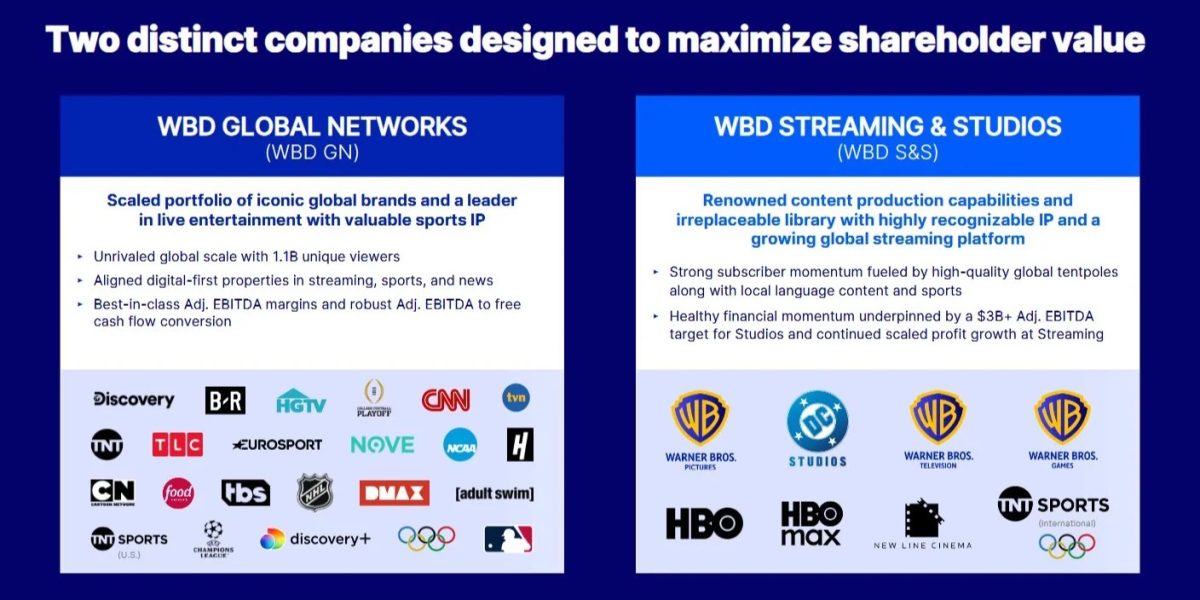
Three public bidders (and one private one) entered the bidding war, with initial bids submitted and reviewed by the WBD board on November 20. In an unusual move, WBD told all the bidders to submit again by December 1, but all of them needed to increase their offer. These four companies all upped their bids, which were made public for the first time in the December 17 SEC filing.
According to the filing, each company was actually bidding for different things:
- Netflix didn’t want all of WBD—instead, they wanted the company to continue its planned split in 2026 so it could acquire WB without DGN. Netflix hoped the acquisition would diversify their business into new revenue streams of theatrical distribution, linear television production, premium television through HBO, and gaming.
- Conversely, Starz (the only company to not publicize its bidding) didn’t want WB at all: they only wanted Discovery Global Networks and HBO/HBO Max. Since no one on the WBD board wanted to part HBO from WB, this offer was quickly voted down.
- Comcast, owner of competing media giant NBC-Universal, wanted all of WBD because, like WBD announced in June, they too plan to split their company in two in the near future, and in the same way. Comcast will be all of the company’s internet and cable assets while NBC-Universal will be all the studio and streaming assets. By acquiring WBD, they could make both companies more desirable to future buyers by adding WB to NBC-Universal (and rplacing the fledgling Peacock with HBO Max) and DGN to Comcast.
- Finally, Paramount-Skydance (also known as PSky in the document from its stock listing) wanted to buy and keep all of WBD to bolster its own business. It would disolve HBO Max and move all of its content to Paramount+ and eventually move all of Warner Bros. operations under the Paramount banner.
Why PSky Wants Warner

While Netflix wants WB for diversification and Comcast wanted WBD for arbitrage, PSky wants WBD for media consolidation. To understand why, one must look at how Paramount and Skydance became Paramount-Skydance earlier this year.
Skydance Media was created by its current CEO David Ellison in 2006. The small studio quickly became a big investor and distributor, in part because David’s father Larry Ellison is one of the richest men in the world and could backstop the company’s riskier projects. Skydance teamed with Paramount Pictures in 2009 and co-financed almost all of their films for five years.
With the co-financing contract set to end in 2024, Skydance decided that its partnership had been so successful that it wanted to buy Paramount from the Redstone family—this included not just Paramount Studios and Paramount+ but also CBS, MTV networks, Comedy Central, USA Networks, Showtime, Pluto TV, and half of Miramax. On July 7, 2024, Paramount agreed to the merger, which took 13 months for the federal government to approve.
Ellison isn’t resting on his laurels, however, and wants Skydance to consolidate more American media. By scooping up Warner Bros. Discovery with all the cable assets, Skydance would have a majority of the traditional cable channels while doubling the size of their movie and TV library and adding a profitable streaming service to its company.
PSky’s Politics Take Center Stage
But why did PSky target Warner Bros. specifically? After all, Comcast has admitted it wants to sell NBC-Universal in a couple of years, and the Ellison fortune could easily scoop up popular small indie studios like Neon and A24. It likely has a lot to do with Donald Trump.
Trump and the Ellison family are close friends, and the president is a good friend to have when your business merger has to go through government approval. Trump helped facilitate their acquisition of Paramount this year, and the Ellisons likely don’t want to risk a timeline where Comcast or the other studios aren’t ready to sell for a couple more years and he’ll face a regulatory environment without a buddy behind the scenes.
Ellison has heavily implied that the Trump administration would block any buyer of WBD that wasn’t PSky. On December 1, days before WB declared Netflix the winner, PSky’s lawyers sent a 4,000 word letter to WBD claiming that, “While a proposed Paramount/WBD transaction would be pro-competitive and likely have a favorable and relatively smooth approval process by regulators, a transaction with either Netflix or Comcast would face grave uncertainty and significant opposition by competition law enforcement agencies in the U.S. and abroad.”
However, WBD wasn’t originally going to sell this year—they wanted to wait until they split the company, but PSky was pressuring them to sell with three unsolicited offers made before the October 21 bidding announcement. So the question remains: Why WBD?
PSky’s Alleged Plan for a Conservative Coop
According to Hollywood insiders who spoke to the AP, PSky wants two of WBD’s assets more than anything else: HBO and CNN, and both partly for political reasons. While acquiring HBO Max could allow PSky to become a top competitor in streaming, HBO has also been home to shows very critical of Trump and the Ellisons, specifically Real Time with Bill Maher and Last Week Tonight with John Oliver. Just as CBS cancelled The Late Show with Stephen Colbert under suspicious reasoning, insiders believe Maher and Oliver would be cancelled under PSky.

CNN would also likely be the target of editorial censorship by PSky. Trump has been publicly critical of CNN consistently through both terms of his presidency and said on December 10 that “I think CNN should be sold, because I think the people that are running CNN right now are either corrupt or incompetent.” After acquiring CBS, PSky brought Bari Weiss in to realign CBS News toward pro-conservative coverage, and that move would likely be duplicated at CNN.
Hollywood pundits have also pointed out that PSky could bring more conservatism to WB and HBO. After Disney-Fox, the Hollywood studio with the most films boycotted for being to be “too woke,” has been WB. Conservative figures like Ben Shapiro and Candice Owens regularly target WB films like Barbie, Superman, The Matrix Resurrections, and One Battle After Another, and some filmmakers worry that those films would never have happened if PSky was in charge.
While these political matters are not the main catalyst for PSky pursing WBD, they have factored into the public perception of PSky’s drive to get WBD. In truth, it’s more likely that PSky knew WBD would be for sale soon anyway and thought they could nab the whole company before it split in two and would cost them more money to acquire both halves.
PSky Gets Rejected and Gets Hostile
Whether they are primarily motivated by money or politics, PSky wants WBD and is not taking no for an answer. On December 4—the same day WBD announced that Netflix would be its business partner—PSky’s lawyers sent a letter claiming that the bidding was “a tilted and unfair process” and that WBD was always planning to pick Netflix and never gave them a real chance. To that end, Ellison launched a hostile takeover bid on December 8. The deal was the same as what they offered on December 4, and Ellison gave WB ten days to consider the deal and avoid a protracted battle.
Ultimately, the WBD’s board resoundingly rejected the takeover offer. “The PSKY offer is illusory [. . .] and would make Hollywood weaker, not stronger. Following a careful evaluation of Paramount’s recently launched tender offer, the Board concluded that the offer’s value is inadequate, with significant risks and costs.”
Not only did the WBD unanimously reject PSky’s hostile bid on December 17, but they also launched a website with Netflix the same day to show what the new company will look like after the merger. Not only did they launch a website, but WBD had the heads of Netflix tour their Burbank studio while flanked by press that same afternoon.
Yet PSky is still not giving up—they’ve launched their own website and are preparing for war. Ellison now has until the 30-day window ends on January 8 to get 90% of the WBD stockholders to go against the board and side with PSky’s offer. After that, the company may adjust their $30/share offer, extend their takeover timeline, or focus their efforts on trying to get government regulators to block the Netflix acquisition.