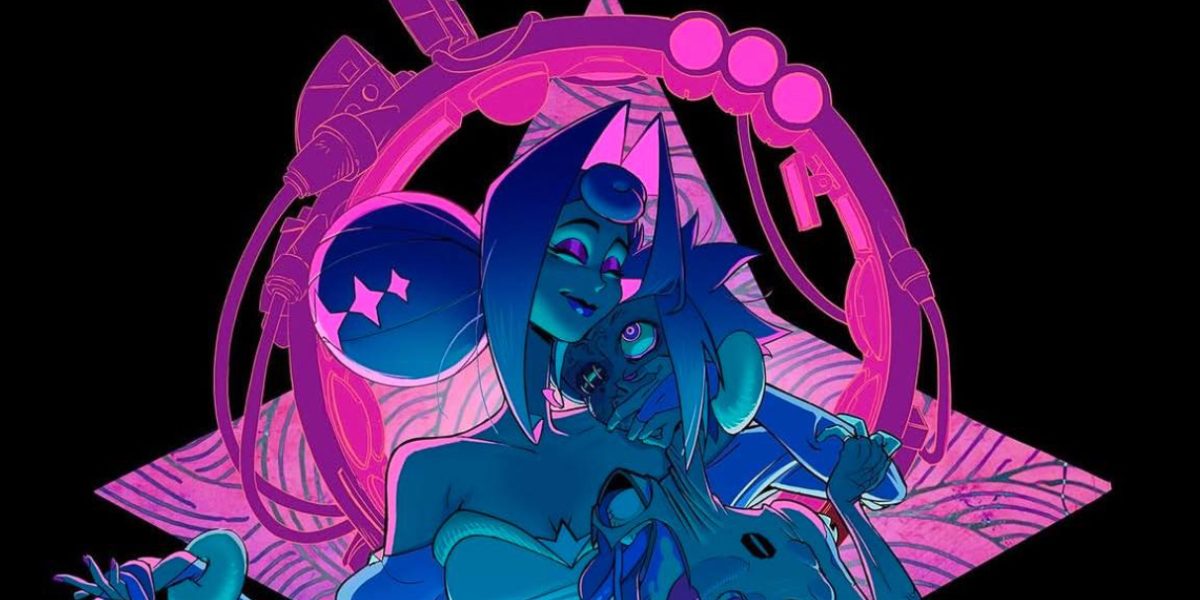
















While the second part of Wicked may steal all the musical headlines this weekend, a different, less family-friendly musical just wrapped its second season. Vivienne Medrano’s Hazbin Hotel, which can be watched on Amazon Prime, gained infamy as the first independently produced animated show to move from YouTube to a major studio (which is now becoming an industry trend). Despite a five-year wait between the original pilot and its first season, Hazbin Hotel and its sister series Helluva Boss have amassed positive reviews and a massive fanbase.
Similar praise can be given to Hazbin Hotel’s second season, which premiered on October 26 and wrapped on November 19. The show was bigger than season one in every way: more songs, more settings, more characters, and a bigger villain with much bigger stakes. However, this season didn’t include more episodes to cover its expanded world, and as a result, the eight season two episodes felt overstuffed and rushed even while maintaining great quality animation and music. Overall, the second season is a fun watch with the same Hazbin Hotel magic but is a definite decline in quality from the first season.
The premise of Hazbin Hotel is simple: Lucifer’s daughter Charlie Morningstar (voiced by Erika Henningsen) opens a hotel in Hell where she hopes she can rehabilitate sinners and get them into Heaven. Season two picks up immediately in the aftermath of the season one finale, where a battle against Heaven and their exterminator angel army ended in the death of Adam, the first man.
The battle with Heaven has made Charlie’s hotel popular with sinners for all the wrong reasons—Adam’s death showed Hell that angels can be killed, and most of the new arrivals want to attack the pearly gates. This becomes the plan of Vox (Christian Borle), a flat-screen-headed media mogul who plans to tarnish the hotel’s reputation and get his revenge on his rival Alastor (Amir Talai), who was Charlie’s advisor all through the first season.
Meanwhile, Charlie mourns the loss of her friend Sir Pentious (Alex Brightman), who sacrificed his life to save her and her friends from Adam. Unbeknown to her, Sir Pentious is not dead but has ascended to Heaven. He’s proof that Charlie’s hotel works, but he’s unable to tell Charlie. His appearance in Heaven and Adam’s death shocked the leaders of Heaven, who have sealed off the realm for protection.
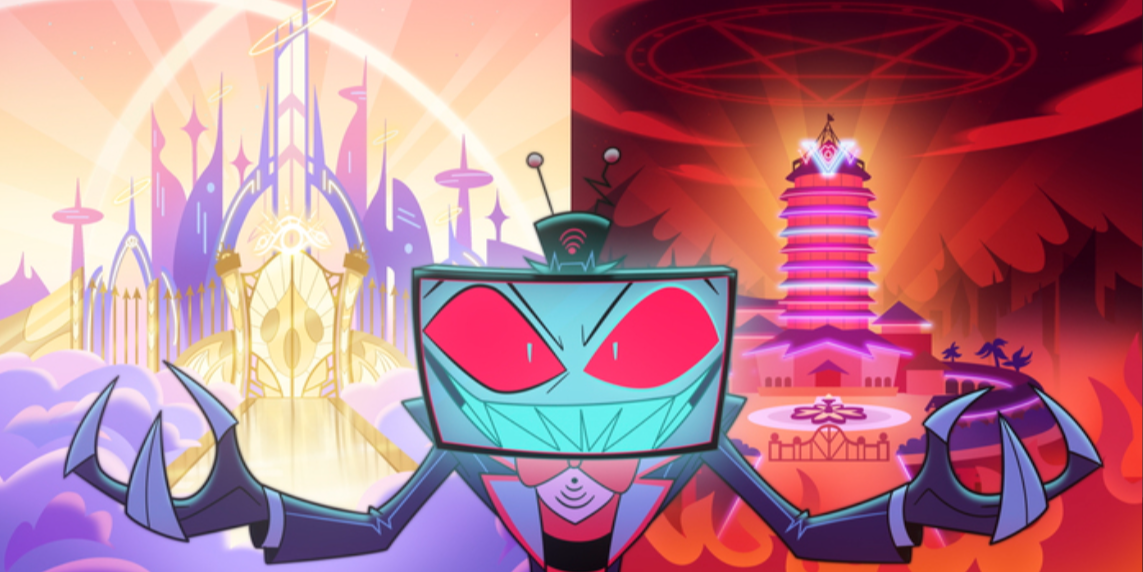
While these two conflicts—Vox’s rise to power and Charlie’s inability to prove to others that her hotel works—are the main story threads for the season, there are more. In fact, there are too many. Season two suffers from significant pacing problems because it tries to fit too much into just eight 25-minute episodes.
The main cause for this is that there are too many characters this season tries to focus on. Season one has a big cast of 9 central characters (those who played a significant role in three or more episodes) and 12 recurring characters (those who were part of the story and the songs in just one or two episodes). While the cast was big, new characters were introduced gradually with a couple of new faces each episode. Every character also has a role in the storyline—Charlie needs to prove the hotel works to stop the next angelic extermination, and every character introduced either helps or hurts her cause.
Season two, however, elevates several characters to a more prominent role, so this season has 17 central characters and 9 recurring characters. A more important role requires more screen time to explore that character’s story arc, and there simply weren’t enough episodes to do this. Instead, storylines are rushed, characters are left undeveloped, and what should be significant moments for characters are just ignored.
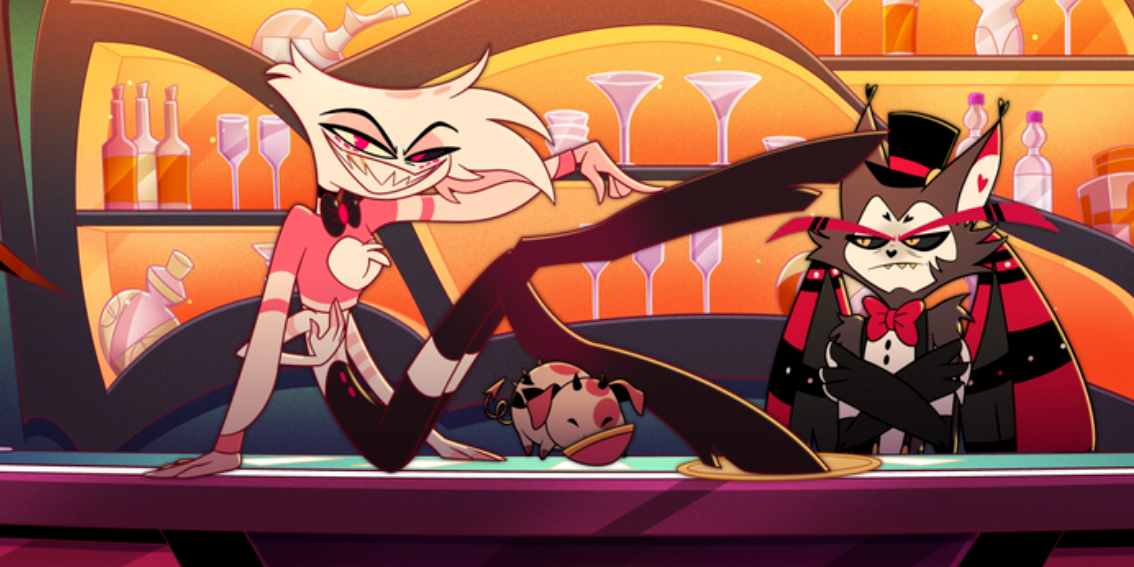
Take Angel Dust, one of the most popular characters (and my personal favorite). Season one addresses his sinful behavior, his abuse at the hands of his boss, his struggles to reform, and his strained relationships with everyone else at the hotel. By the end of the season, every one of these plot points has a payoff as he gets clean, stands up to his boss, embraces Charlie’s therapy, and befriends everyone at the hotel.
Season two, however, does Angel Dust dirty. In episode 3, his relationship with Charlie becomes strained after she learns the reason Angel Dust went to Hell and why he doesn’t believe he can be redeemed. However, neither of these plot points are revisited in the remaining episodes; in fact, Angel is almost entirely absent until episode 6, where he faces a new crisis of faith in himself when the previous one hasn’t been resolved.
Almost every character suffers from this rushed plot development. Every new character is introduced in the first two episodes and is given a single character trait: new hotel resident Baxter is a mad scientist, Adam’s son Abel is a coward, and so on. By the finale, every character tries to complete their arc, but it’s hard to care when they’ve had so little development.
It seems like the writers were aware of the problem: there’s a new hotel resident who appears in almost every episode but isn’t acknowledged by name until the finale as a joke. However, knowing that there’s a problem isn’t the same as solving the problem.
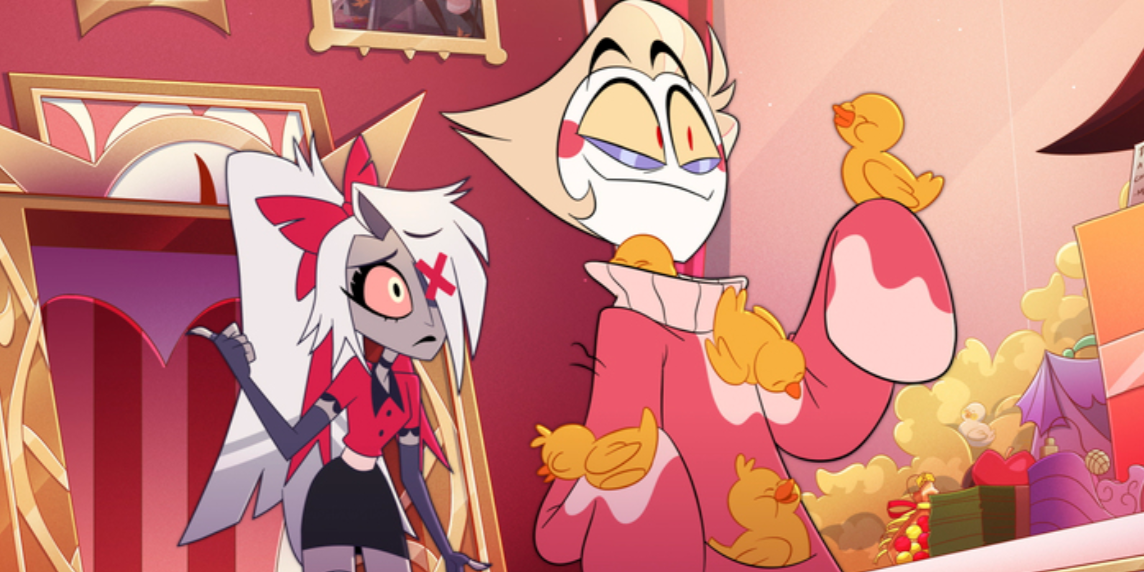
It also doesn’t help that many of the returning characters act severely out of character. Two employees of the hotel suddenly quit for no reason other than to create drama, as they both eventually return. Relationships that the show wants the audience to care about blossom out of nowhere, while others fracture for no clear reason.
The worst offender here is the most prominent character, as Charlie goes from sympathetic to annoying real fast. The princess, who in season one cared about everyone intensely, suddenly started putting lives at risk intentionally and became baited into popularity contests. While this was the point of her character arc, the way it was executed made Charlie into the most unpleasant part of the show (second only to her father Lucifer, who became a complete idiot and the butt of every joke this season).
There were two exceptions, however: Vox and Sera, the head seraphim in Heaven voiced by Patina Miller. As the main antagonist of the season, Vox was prominent in all but one episode, was given a complete backstory, and had a prominent solo (if not the whole track) in eight of the season’s twenty songs. While he had a very standard but enjoyable villain rise and fall arc, Sera’s arc was the most satisfying, as she grappled with her guilt in the past exterminations and her struggles with how to move not just herself but Heaven forward as their leader. Not coincidentally, Sera got two prominent duets to explore her character, while Charlie only had a single duet.
Speaking of the music, the songs this season were more extreme than the first—the highs were higher, but the lows were lower. This all comes down to the writing, not the vocals—every cast member still blows away every performance, just like in season one. This season adds the vocal talents of Patrick Stump from Fall Out Boy as Abel and Liz Callaway, who voiced Anastasia in the 1990s animated movie, as the Speaker of God. While most of the songs are still memorable and clever, there is a distinct shift in this season’s songs toward a larger variety in styles, some that worked and others that did not.
A big reason for this was a shift from the Disney-style tracks of the first season to the more theatrical Broadway tracks of the second. This season had a lot more patter in songs, more reprises, and more group numbers with a chorus. While this change made the show feel more theatrical and gave the songs more significance, there’re not as many songs that could go viral or be added to a workout playlist like season one’s “Hell is Forever,” “Poison,” or “Loser Baby” (really, the hard rock banger “Gravity” from episode two is the only one that comes to mind).
Of the more theatrical songs, the finale’s “Hear My Hope” from the last episode is the best, and like last season’s final song, almost every cast member adds to the track. The song is both uplifting and musically complex despite a couple musical interludes (one of which works well, the other of which feels very out of place despite it sounding great). If Hazbin Hotel ever becomes a stage show (and if it remains as profitable as it has been, it surely will), this will become a Broadway standard.
At the other end is “Speedrun to Redemption” from episode three, which is the worst in the entire series. Sung by a manic Charlie at breakneck speed, this song lacks the clever wordplay the series is known for and instead is the first in the series to use unrelated ideas and remarks just to fit the rhyme scheme. The song embodies everything that’s wrong with the season: it’s too fast, too shallow, and not at all memorable.

The only significant improvement season two made over season one is the animation. Season one was beautiful but was criticized for having a mostly-red color palette and some simple character designs. Season two has a bigger variety of settings and uses every color to make the world feel more vibrant (though there’s still plenty of red—it’s set in Hell, after all). Existing characters get more outfit changes in this season to show off the versitiity of Medrano’s character designs, and new characters have outfits with more intricate lines and textures.
The upgrade in animation also came with more camera movement and immersive fight scenes. As the Spindlehorse team gets more comfortable with what they can do with the show’s look, the more the show plays with zooms, pans across multiple characters, and rolls and adjustments to give the impression that there’s an actual camera filming the series. There are two episodes with extended battle scenes, and each one is captivating due to the camera movement feeling like it can barely keep up with the action.
Despite some issues with season two, Hazbin Hotel is still required viewing for any fan of musicals and adult animation. The final two episodes do a lot to elevate the overall season, but the characters and story are still intriguing, and the music in the series is still better than any Disney film in the past decade. The resolution also creates a great setup and new status quo going into season three that has the potential to be great. Though it has some notable flaws, season two of Hazbin Hotel still shows viewers what it actually means to be fun as Hell.